Most people shopping for a big and tall gaming chair are solving the wrong problem. They read the weight rating, they check the height range on the listing, and then they sit down in something that technically holds them and still wrecks their lower back by hour three.
I coach esports full time in Los Angeles, after a decade of ten hour practice days as a competitive FPS player. I have watched a 24 year old on my own roster get a herniated disc scare from a chair that was rated for him and adjusted for nobody. So when I say a chair fits, I mean four things line up at the same time: seat depth, seat width, lumbar height, and armrest position. If one of those is off, you did not buy a chair. You bought a bench with wheels.
The process below is the one I run with my players. It takes about 20 minutes, one tape measure, and a wall to sit against. It works on any big and tall gaming chair, including the two I keep pointing people toward when they ask me what to order.
Why you should trust me
I have spent ten years sitting in chairs for a living and the last several of those coaching other people on how to sit in them. My back is the reason. I was the guy who ignored the ache at hour six, kept grinding ranked until 3 a.m., and ended up in a physical therapist's office being told that the curve of my spine had flattened out. The therapist who fixed me taught me that "support" is a measurement, not a feeling, and I have measured every chair against that standard since.
I do not take money from chair brands, I do not write about a chair until I have checked whether the lumbar actually moves, and I will tell a player to buy the cheaper chair when the cheaper chair is the honest answer. That is the whole qualification.
What "big and tall" actually has to mean
Weight rating is the least interesting number on the box. A 400 pound rating tells you the gas lift and the base will not fold under you. It tells you nothing about whether the seat is deep enough for a long femur, or whether the lumbar curve lands above your belt line instead of in your kidneys.
Three numbers matter more than the rating. Seat depth, seat width, and how much the lumbar support moves. A chair can be rated for 400 pounds and still ship with a 19 inch seat pan that leaves your thighs hanging off the front edge. That chair will hold you and it will still hurt you.
Here is the test I use, and it is not complicated. If the seat is too short, your weight lands on your sit bones and your lower back has to work all day to hold your torso up. If the seat is too long, the front edge digs into the back of your calves, you slide forward to escape it, and you end up perched on the edge with no back support at all. If the lumbar is a fixed bump in the wrong spot, it pushes your mid back forward and pulls your lower back out of its natural curve. Every one of those failures shows up as pain in a different place, and none of them show up in a weight rating.
How to measure yourself before you shop
Do this with a tape measure and a hard chair. Write the numbers down and keep them on your phone, because you will need them in the store or on the product page.
Step one: seated hip width. Sit down, feet flat, and measure across the widest part of your hips. Add two inches. That is your minimum seat width. Most big and tall chairs list something in the 21 to 24 inch range, and if the seat is narrower than your hips plus two inches, the bolsters will push your knees inward and roll your pelvis backward.
Step two: seat depth. Measure from the back of your backside to the back of your knee, then subtract two to three inches. That is your target seat depth. This single number eliminates more chairs than any other measurement.
Step three: lumbar height. Find the top of your hip bone. Measure from the seat surface up to that point. The center of the lumbar support should land at or just below that line, never above it.
Step four: elbow height. Sit with your shoulders relaxed and your forearms parallel to the floor. Measure from the seat to the bottom of your elbow. Your armrests should top out at that number or a hair under it. Armrests that sit too high lift your shoulders and pull your neck forward.
Step five: the foot check. Once the chair is at the height where your elbows meet your desk, look at your feet. If they are floating, your thighs are bearing weight they should not be, and you need a footrest or a lower desk. This is the step people skip, and it is the one that decides whether hour six feels like hour one.
Two chairs that fit the checklist
Both chairs below are built for larger bodies, and both show up on my short list when readers ask what to actually order. Neither one is a bucket seat, which is the entire point.
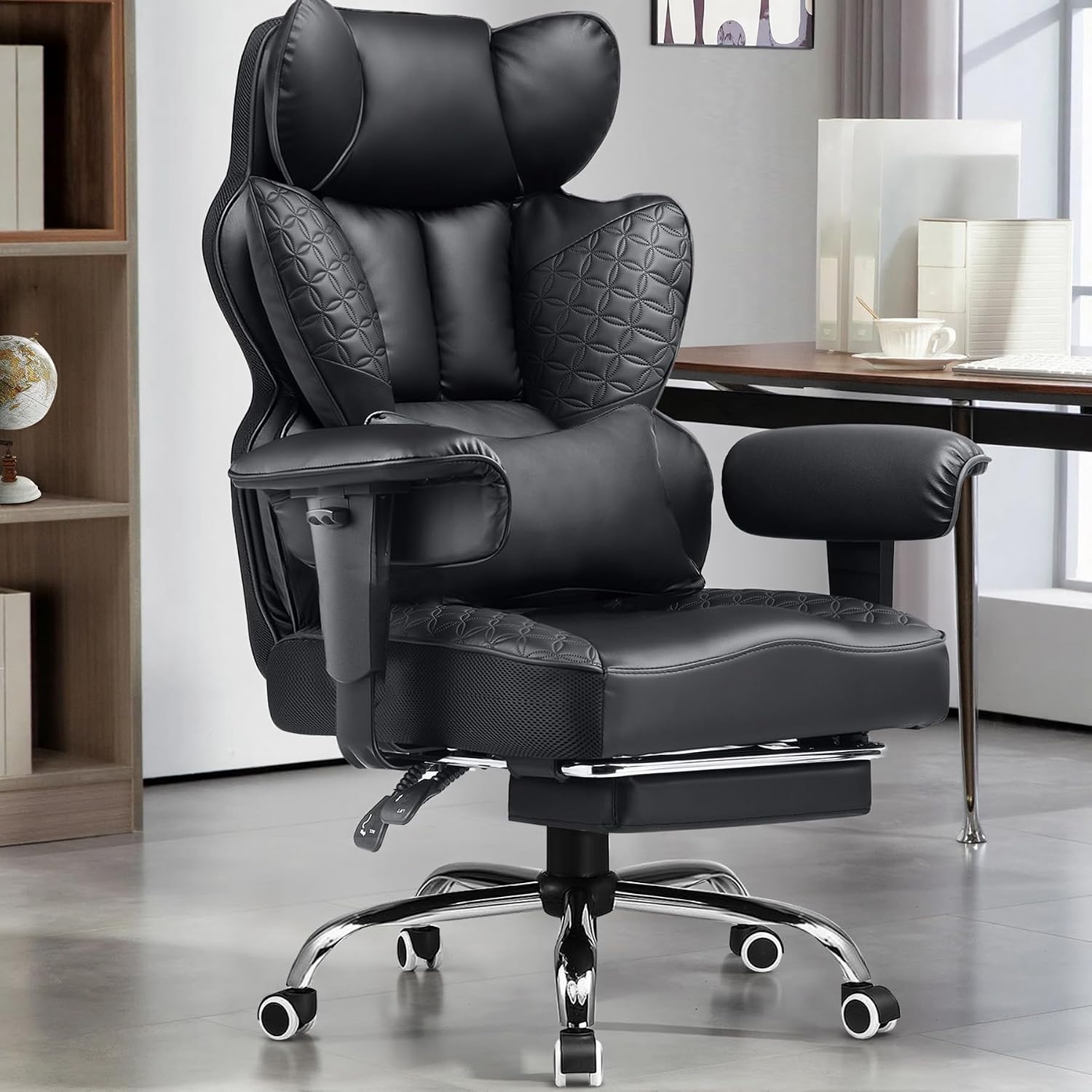
Our pick: GTPLAYER Big and Tall Gaming Chair 400lbs Heavy Duty Office Chair with Foot Rest & Ergonomic Pocket Spring Lumbar Support, High Back 3D Saddle Shaped Cushion for Back Pain Relief, Matte-Black
 Visit on Amazon →
This is the first name I give anyone who asks for a big and tall gaming chair. Check current Amazon price.
The listing describes a 400 pound rating, a high back, a 3D saddle shaped cushion, and pocket spring lumbar support. Read that last part twice, because pocket spring lumbar behaves differently from a molded foam bump. Foam compresses once and stays compressed, which means the curve you felt in the showroom is gone by week three. A spring element pushes back, so the support is still there at hour six of a scrim day.
The saddle shaped cushion matters for bigger frames as well. A flat seat pan concentrates your weight under two points and leaves your thighs unsupported. A shaped pan spreads the load across the seat and lets your pelvis sit level, which is what keeps your lower back in neutral instead of rounded.
The footrest is the feature people underestimate. Once the chair is raised high enough that your elbows meet the desk, a taller frame often ends up with floating feet, and floating feet mean your thighs carry the load. A footrest fixes that without lowering the desk.
Flaws but not dealbreakers: The listing does not spell out how much the lumbar unit moves, so if the top of your hip bone sits unusually high or low relative to your torso, ask before you order. And the silhouette is still a gaming chair, so if you need something that reads as office furniture for a client facing room, look at the second pick below.
Anyone with a longer torso, a heavier frame, or a history of lower back trouble should start here.
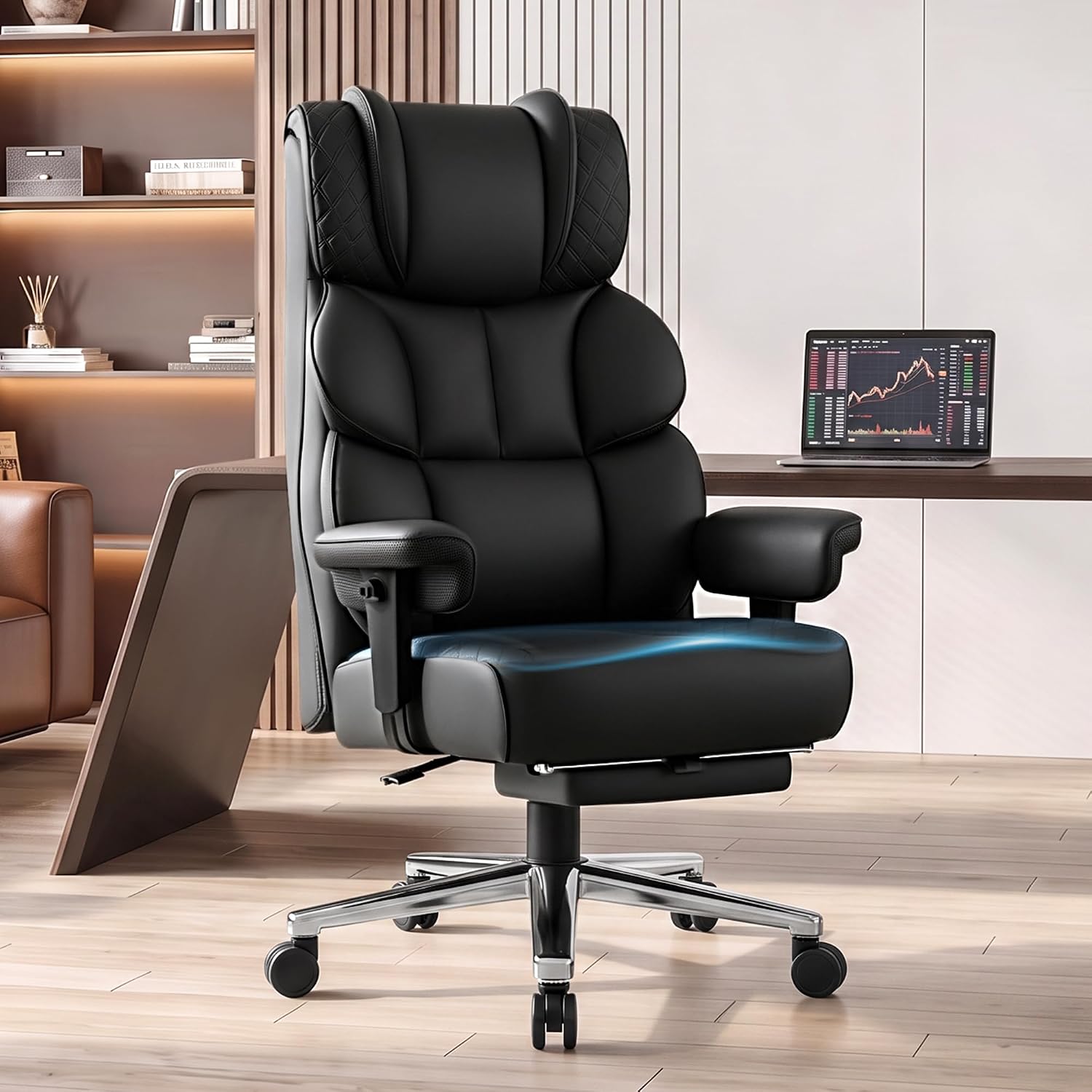
The alternative: Big and Tall Office Chair with Retractable Footrest, Comfortable Desk Chair
 Visit on Amazon →
If you want the look of an office chair instead of a gaming chair, this is the second name on my list. Check current Amazon price.
The name tells you most of what you need to know: big and tall sizing, a retractable footrest, and a desk chair profile. The retractable footrest is the same fix described above, and it is the reason this one lands on my list at all. A footrest that slides away when you are not using it means the chair does not eat floor space in a small room, and it means you can still put your feet down flat when you are standing up and sitting down a dozen times an hour.
The desk chair profile is not a small thing either. If your setup doubles as a workspace, or if you record on camera, the plain look does a lot of work that a racing silhouette cannot. I have players who stream from a shared office and this is the style they end up with.
Flaws but not dealbreakers: A retractable footrest is a moving part, and moving parts are where budget chairs fail first. Treat it like a mechanism, not a step, and it will hold up. Also check the seat depth against the number you wrote down, because a big and tall office chair and a big and tall gaming chair do not always measure the same in the pan.
Anyone who wants ergonomics without the racing aesthetic, or who shares a room with people who do not want to look at a gaming chair, should look here.
The 20 minute setup workflow
Now the part that actually changes how your back feels. Do this once, on the day the chair arrives, and then leave it alone.
Set seat height first. Raise or lower the chair until your forearms are parallel to the floor with your hands on your keyboard. Nothing else can be set correctly until this is right, because every other measurement is taken from the seat.
Set seat depth second. If the pan slides, move it so there is a two to three finger gap between the front edge and the back of your knee. If it does not slide, use a firm lumbar cushion behind you to take up the extra length. Do not fix a too deep seat with a pillow under your thighs. That just raises your knees and rounds your back.
Set lumbar height third. Find the top of your hip bone with your thumb. The center of the lumbar support should sit at that height or a finger below it. If the support is adjustable, this takes ten seconds. If it is fixed and sits too high, no amount of adjusting anything else will save the chair.
Set the armrests fourth. Drop them until the pads meet the bottom of your forearms without lifting your shoulders. If they adjust in more than two directions, pull them in until your elbows sit directly under your shoulders and angle the pads so your wrists stay flat. Armrests that only go up and down are the reason your shoulders ache at hour five.
Set tilt tension fifth. Lean back. The chair should follow you with resistance, not dump you backward and not lock you upright like a school desk. Find the tension where you can lean back a few degrees and stay there without holding yourself up with your abs. Then lock the tilt if your chair allows it. A locked, slightly reclined backrest is the most supportive position for a long session, because it takes the load off your lower back entirely.
Recheck at the 30 minute mark. Sit for half an hour, then repeat the elbow and foot checks. Almost everyone drifts. You will find your seat has crept down or your armrests have crept up, and you will correct it once and then it holds.
What to skip
Skip anything with a bucket seat racing design. It is a car seat bolted to a base, and car seats are shaped to hold you in place against lateral G forces that do not exist at a desk. The bolsters push your shoulders forward and roll your pelvis back, which is the exact posture your physical therapist will spend six months undoing.
Skip fixed lumbar bumps. If the support does not move, it is decoration that happens to be shaped like ergonomics.
Skip armrests that only adjust up and down. Three dimensions is the minimum for a serious chair, and four is better.
Skip anything that wobbles after six months. A chair that rocks side to side while you type is a chair that is teaching you to sit crooked.
What this all costs
I am not going to quote you a price, because listings move and a number in an article is stale by the time you read it. Check current Amazon price on both chairs and compare them against what a single visit to a physical therapist costs in your city. That comparison tends to end the debate quickly.
The setup itself is free. Twenty minutes, one tape measure, and one wall. The chair is the purchase. The fit is the part that decides whether you get eight hours of work out of it or two hours and an ice pack.
Do the measurements before you buy, do the setup the day it arrives, and recheck it once a month. Your back is the only piece of hardware in your setup you cannot replace.
That is the job. Sit properly or do not sit long.