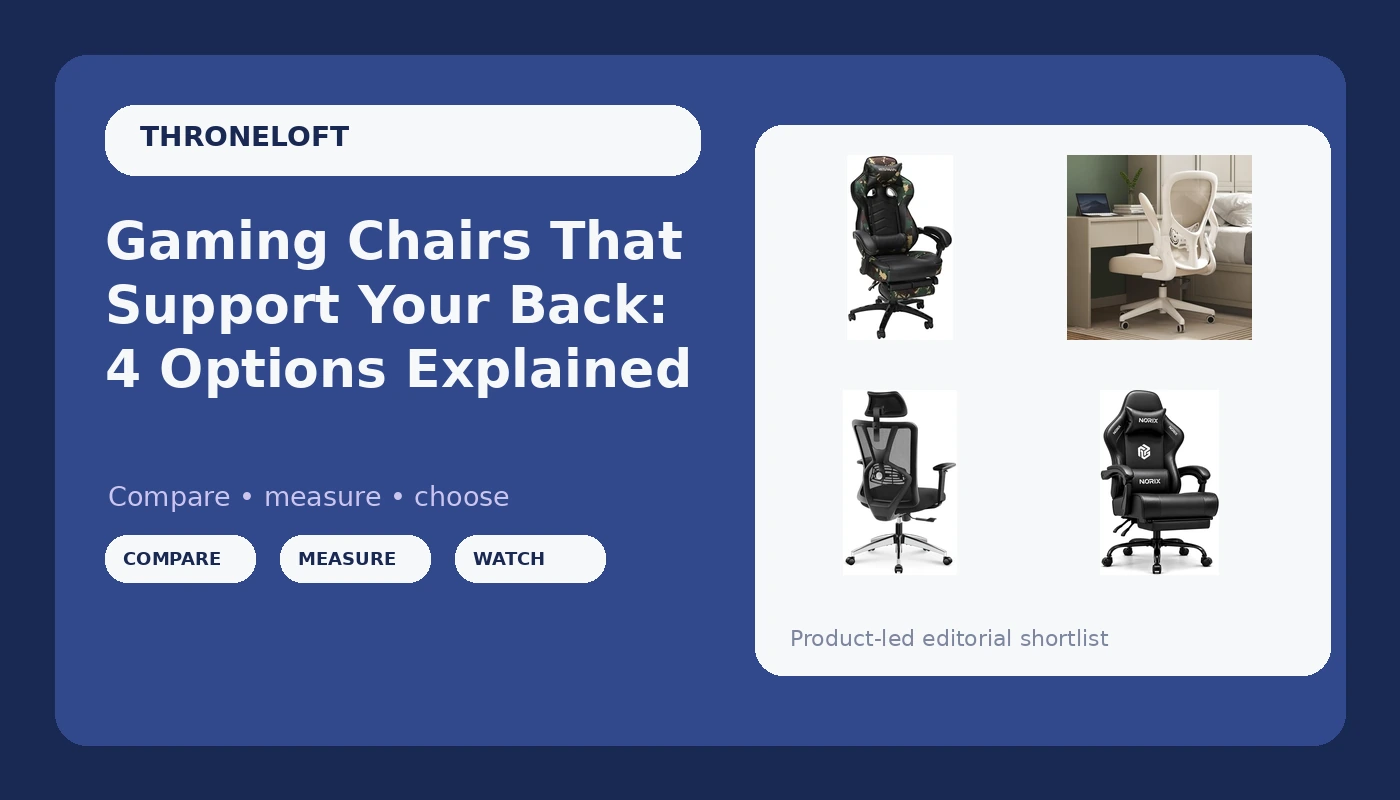
Most people shopping for ergonomic gaming chairs start with the wrong question. They ask which one looks fastest, which one matches the setup, which one has the biggest backrest. The question that actually decides whether you can stand up straight after hour six is narrower: which chair lets you move lumbar support, seat height, tilt lock, and armrests until your skeleton carries the load instead of your lower back muscles. A chair is a chair first and a gaming product second. This explainer walks through four options, what each one is built around, and how to fit one to your body before you spend anything.
Related: How to Set Up a Gaming Chair for Long Sessions →
Quick answer
The Ticova Ergonomic Office Chair lists the widest adjustment set of the four, with adjustable lumbar support, 3D armrests, and a 130 degree recline plus rocking, which is why it is the first one to look at if support is your priority. The Hbada is the mesh option with flip-up armrests and a smaller footprint. The RESPAWN 110 is the recliner of the group, built around a footrest and a racing-style high back. The Gaming Chair for Adults is the entry point if budget is the constraint. None of these is universally best; the right pick depends on your height, your desk, and how long you actually sit.
Four useful options
| Model | Best fit | What stands out |
|---|---|---|
| Ticova Ergonomic Office Chair | Long sessions where support adjustability matters | Adjustable lumbar support, 3D armrests, 130 degree recline and rocking, rotatable headrest |
| Hbada Office Chair | Smaller rooms and desks where armrests get in the way | Breathable mesh, adjustable lumbar support, flip-up armrests, tilt function, PU silent wheels |
| RESPAWN 110 Gaming Chair | Downtime between matches and reclined viewing | Footrest recliner, racing-style high back, 360 swivel, adjustable lumbar support, headrest pillow |
| Gaming Chair for Adults | First chair on a tight budget | Adult-sized gaming chair described by the maker as an upgraded model |
The most adjustable of the four: Ticova Ergonomic Office Chair
The trade-off here is that mesh and a thick seat cushion pull in different directions. Mesh keeps air moving across your back, which matters in a warm room during a long session, while the cushion is there for pressure relief under your thighs. What you give up is the deep foam-and-bolster feel that racing-style chairs sell. If you have spent years in a bucket-seat chair and liked the way it hugged you, this will feel flatter and more upright. That is the point. Upright and adjustable is what keeps your lumbar curve intact at hour six.
The mesh option with a small footprint: Hbada Office Chair
Flip-up armrests are an underrated feature and also a limitation. They solve the storage problem and the keyboard-clearance problem, but flip-up arms generally adjust in fewer directions than a full 3D or 4D armrest, so you have less control over where your elbows land during play. If your shoulders ache after long sessions, armrest height and angle matter as much as lumbar depth, and this is the area where the Hbada gives up ground to the Ticova. If your chair has to disappear under a desk between sessions, it gives up nothing that matters.
The recliner with a footrest: RESPAWN 110 Gaming Chair
The honest caveat about any recliner with a footrest is that reclining and lumbar support fight each other. When you kick the footrest out and lean back, the angle between your thighs and your torso opens up, and a lumbar pad that felt right when you were sitting upright can end up in the wrong place. That does not make the RESPAWN 110 a bad chair; it makes it a chair for a specific job. Reclined viewing, controller sessions, and between-match downtime are what it is shaped for. If you spend eight hours hunched forward over a mouse, the racing-style bolsters and the reclined geometry work against you.
The budget entry point: Gaming Chair for Adults
The trade-off with any budget chair is information. Premium chairs publish adjustment ranges, weight ratings, and materials because those specs are the product. Budget listings often describe the look and leave the ergonomics vague, which means you are buying on faith. That is not automatically a bad decision. If you are outfitting a second setup, buying a first chair for a teenager, or simply not ready to spend on support you have not learned to use yet, an inexpensive chair that gets you sitting at the right height beats a chair you cannot afford. Just go in knowing that a budget chair is the piece most likely to be replaced first.
Prices and availability may change. Product images, names, and retailer links must be matched by verified ASIN. Do not state a current price, rating, stock status, or measured result without current evidence.
Why adjustable lumbar support beats a racing silhouette
Lumbar support is the curve that holds your lower back. There are two kinds, and only one of them is worth paying for. A fixed bump is decoration: it sits where the manufacturer decided it should sit, which is roughly right for one body type and wrong for everyone else. Adjustable lumbar support moves up, down, and often in and out, so you can put the curve where your spine actually needs it. That single difference is why two chairs with identical silhouettes can feel completely different after four hours.
The rest of the support story follows the same logic. Tilt tension and a lock matter because a chair that only rocks freely forces your back muscles to stabilize you all day; a chair you can lock at a slight recline lets you keep a healthy hip angle without fighting it. Seat depth matters because a seat that is too long pushes the backrest away from your lumbar curve, and a seat that is too short leaves your thighs unsupported. Armrests matter because shoulders and neck follow elbows: if your arms hang or your shoulders shrug, the tension travels upward.
Material choice is the other long-session variable. Mesh breathes, which keeps you cooler and reduces the sweat-and-shift cycle that makes people change position constantly. Foam and upholstery feel plusher at minute five and warmer at hour three. Racing-style bucket seats are shaped for a car, where a harness holds you in place and lateral forces exist. At a desk there are no lateral forces, so the bolsters mostly push your shoulders forward, which is the opposite of what you want.
How to fit a chair to your body before you buy
- Measure your seated knee height from the floor to the underside of your knee, wearing the shoes you normally wear at your desk. Your chair's seat height range needs to cover that number.
- Check seat depth against your thigh length. When your back is against the backrest, you want a small gap behind your knees, not pressure against the back of them.
- Confirm the lumbar support adjusts rather than being fixed, and check how much range it has. If it only moves a centimeter, treat it as fixed.
- Count the armrest adjustment directions. Up and down alone will fit some people; 3D or 4D armrests fit almost everyone, because they also set depth and angle.
- Confirm the chair locks at a tilt angle. Free-floating recline is fine for napping and bad for working.
Practical guidance for long sessions
- Set seat height first, then lumbar, then armrests. Adjusting in that order prevents you from compensating for one setting with another.
- Put the lumbar curve in the small of your back, not under your shoulder blades. If you feel it pressing on your ribs, it is too high.
- Set armrests so your elbows rest at roughly desk height with your shoulders relaxed, not shrugged.
- Use the tilt lock for focused work and unlock it for breaks. Rocking is a movement break, not a working posture.
- Check the return window and the weight rating before ordering, and re-check the hardware after the first month. A chair that wobbles early usually wobbles because fasteners worked loose.
Which option should you choose?
Choose the Ticova Ergonomic Office Chair when support adjustability is the priority and you want mesh, 3D armrests, and a recline you can control. Choose the Hbada Office Chair when the chair has to tuck under a desk or share a small room, and flip-up armrests plus quiet wheels matter more than armrest range. Choose the RESPAWN 110 Gaming Chair when you want a recliner with a footrest for downtime and you like the racing-style look. Choose the Gaming Chair for Adults when budget is the hard constraint and you need a functional adult-sized chair now rather than a perfect one later.
One caveat applies to all four: the details above come from manufacturer listings, not from measurements taken here, and adjustment ranges and materials can change between production runs. Verify the current spec sheet, the weight rating, and the return policy on the listing before you buy, and treat any single review, including a glowing one, as one data point rather than a verdict.
The bottom line
The chair that saves your back is the one you can adjust until it fits, not the one that looks fastest. Rank your needs in this order: adjustable lumbar support, a tilt you can lock, armrests that move in more than one direction, and a seat depth that matches your thighs. The Ticova covers that list most completely of the four, the Hbada trades some armrest range for a smaller footprint and quieter wheels, the RESPAWN 110 is the recliner of the group, and the budget pick gets you sitting correctly for the least money. Whichever you choose, spend the first week adjusting it instead of just sitting in it. That habit is free, and it is the part most people skip.