Most people shopping for a gaming chair start with the colorway and end with regret. I coach esports full time, and I have watched players buy whatever the streamer on their screen was sitting in, then spend the next season shifting their weight every twenty minutes. The difference between a chair you keep for years and a chair you resell at a loss usually comes down to gaming chair lumbar support: whether the lower back curve actually adjusts, and whether the chair lets you lock a tilt angle that keeps your hips level with or above your knees.
The four chairs below are not ranked. They are four different answers to the same question, and only one of them is the right answer for your room, your desk height, and the number of hours you actually sit.
Related: Mesh vs Faux Leather Gaming Chairs: Which One Breathes Better? →
Quick answer
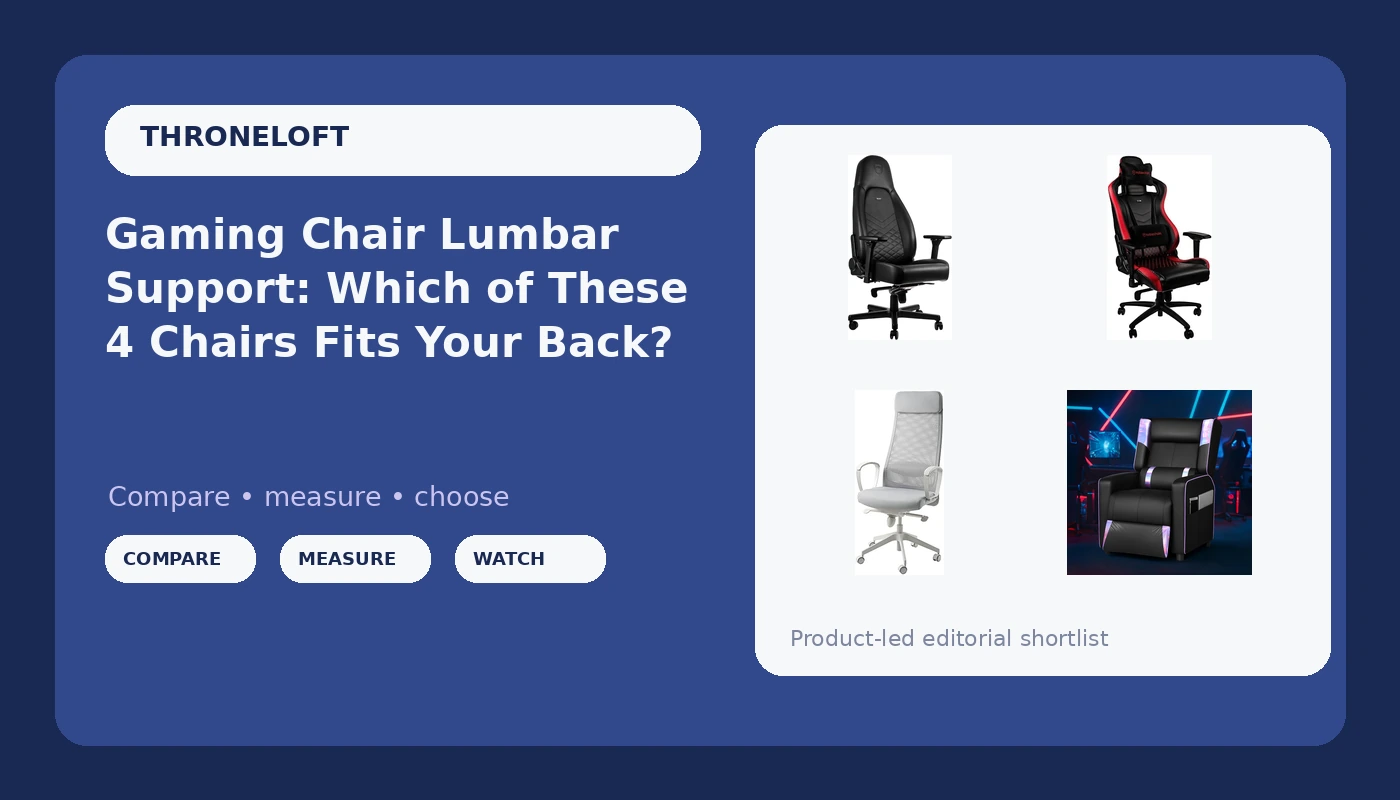
If you want a chair that still looks like a gaming chair but is explicitly built around lumbar support, start with the noblechairs ICON. If a reclining backrest matters most, the noblechairs Epic Mousesports Edition is the recliner of the group. If you would rather have no racing styling at all, the MARKUS office chair is the plain option. And if the chair is going in front of a television rather than under a desk, the LUCKRACER gaming recliner is the only one here designed for that job. Match the chair to the room first, then to your body.
4 useful options
| Model | Best fit | What stands out |
|---|---|---|
| noblechairs ICON Gaming Chair and Office Chair with Lumbar Support, PU Faux Leather, Black | Desk players who want a gaming look with named lumbar support | Listed as both a gaming chair and an office chair |
| noblechairs Epic Reclining Gaming Chair and Reclining Office Chair, PU Faux Leather, Mousesports Edition, Black/Red | Long sessions where a reclining backrest helps | Reclining backrest and a team edition colorway |
| MARKUS office chair, Vissle light grey, Medium | Buyers who want zero racing styling | A straightforward office chair in fabric, not faux leather |
| LUCKRACER Gaming Recliner Chair for Living Room Racing Style Single PU Leather Gaming Sofa for Adults Modern Game Recliners Ergonomic Comfortable Home Theater Seating, Black & Purple | Living room and home theater seating | A single seat recliner rather than a desk chair |
The gaming look with lumbar support: noblechairs ICON Gaming Chair and Office Chair with Lumbar Support, PU Faux Leather, Black
This is the chair I would point a player to first if they want the gaming aesthetic and will not give it up. The trade-off is material. PU faux leather does not breathe the way fabric or mesh does, so in a warm room you will feel it against your back after a couple of hours. That is a real cost, and it is why I keep a fabric chair in my own setup. The other thing to verify before you buy is the lumbar mechanism on the exact version you order. A fixed bump molded into the backrest is decoration. What you want is something that moves up and down so it lands on your curve instead of above or below it.
The recliner: noblechairs Epic Reclining Gaming Chair and Reclining Office Chair, PU Faux Leather, Mousesports Edition, Black/Red
Reclining is not a gimmick, but it is not a posture fix either. A backrest that lays back is genuinely useful for controller play, for watching replays, and for taking load off your lower back between matches. What matters is whether you can lock the recline at a specific angle rather than fighting spring tension all session. If a chair only rocks freely, you will spend the hours bracing instead of sitting. The Mousesports Edition finish matters if you like team-branded gear and matters not at all for your spine. Judge this one on the mechanism, not the logo.
The no-racing-style option: MARKUS office chair, Vissle light grey, Medium
This is the chair for the person who never wanted a racing seat in the first place. It is an office chair in a light grey fabric, listed in a medium size, and there is nothing on it pretending to be a car interior. Fabric generally breathes better than coated faux leather, which matters if you run warm or play in a room without good air conditioning. The trade-offs are cosmetic and practical: fabric is harder to wipe clean than faux leather, and an office chair will never look like a gaming setup on camera. If your back is the priority and the aesthetic is not, that is a fair trade to make.
The living room seat: LUCKRACER Gaming Recliner Chair for Living Room Racing Style Single PU Leather Gaming Sofa for Adults Modern Game Recliners Ergonomic Comfortable Home Theater Seating, Black & Purple
Do not buy this one for a desk. A single seat gaming recliner is shaped for lounging, and its priority is comfort in a living room or home theater, not keyboard-height posture across eight hours. A racing style recliner puts you in a relaxed, reclined position that works for a controller and works badly for a mouse and keyboard. Where it fits: a spare room, a console setup, a movie corner, or a second seat next to the desk. If your actual problem is lower back pain at a desk, this is the wrong category of product, however good it looks in purple.
Prices and availability may change. Product images, names, and retailer links are matched to verified listings. No current price, rating, stock status, or measured result is stated here without current evidence.
Why lumbar support is the spec that matters
Lumbar support is the curve that holds your lower back. Two chairs can both advertise it and behave completely differently. A fixed bump is molded into the backrest at one height, and it either lands on your lumbar curve or it does not. An adjustable pad moves up and down, and often in and out, so you can place the pressure where your spine actually needs it. That single distinction separates a chair you can sit in for six hours from a chair you tolerate for one.
Here is why it matters over a long session. When your lower back has nothing supporting its natural inward curve, the muscles along your spine work continuously to hold you upright. That is fine for twenty minutes. Across six hours it turns into fatigue, then aching, then the slouch that pushes your neck forward and your shoulders up around your ears. I have watched a herniated disc end a competitive career at 24, and it did not happen in one session. It happened across a few thousand hours of sitting in whatever chair was closest.
The second spec is tilt. A chair that only rocks freely forces you to hold a position with your own muscles. A chair that locks lets you set an angle where your hips sit at or slightly above your knees, which takes load off the lower back and stops your pelvis from rolling backward. The third is seat depth: too long and the front edge digs into the back of your knees, too short and your thighs hang with nothing under them. The fourth is armrests. If they only move up and down, your shoulders will eventually pay for the gap.
How to check fit before you buy
- Measure your seated knee height and the clearance under your desk. A chair that cannot drop low enough leaves your feet dangling, and a chair that cannot rise high enough leaves your elbows below the desk.
- Read the lumbar description closely and confirm whether the support adjusts. The word "lumbar" in a title does not tell you if the pad moves.
- Check that the tilt locks at an angle, not just that the backrest reclines. A recline you cannot hold is a nap function, not a posture function.
- Count armrest adjustment axes. Two axes is a start, three or four is the difference between a chair that fits and a chair that fits you.
- Match the chair type to the room before anything else. A desk chair belongs at a desk, and a lounging recliner belongs in front of a screen you are not typing at.
Practical guidance for the first week
- Set seat height so your feet rest flat and your thighs sit roughly parallel to the floor.
- Adjust the lumbar pad until you feel gentle pressure in the small of your back, not a shove into it.
- Lock the tilt for focused work, then unlock it during breaks so your back moves through a range instead of freezing in one position.
- Set armrests so your elbows rest near a right angle with your shoulders relaxed and your wrists straight.
- Stand up every 45 to 60 minutes. No chair, at any price, undoes eight hours of uninterrupted sitting.
Which option should you choose?
Choose the noblechairs ICON when you want gaming-chair styling and the lumbar support named in the listing, and you accept that faux leather runs warmer than fabric. Choose the noblechairs Epic Mousesports Edition when a reclining backrest matters more to you than anything else and you like the team colorway. Choose the MARKUS office chair when you want a fabric office chair with no racing design and you are shopping by posture rather than by looks. Choose the LUCKRACER gaming recliner when the chair lives in a living room or home theater and the desk is not part of the plan.
One caveat applies to all four. None of these listings publishes a full ergonomic breakdown, and no chair is a substitute for a medical assessment if you already have back pain. Treat the listing copy as a starting point, then verify adjustability, dimensions, and the return policy on the current product page before you commit.
The bottom line
You do not need the most expensive chair in this group. You need the one whose shape matches how you actually sit. If you spend hours at a desk, prioritize adjustable lumbar support, a tilt you can lock, and armrests that move in more than one direction. If you spend your evenings on a couch with a controller, a recliner is the honest answer and a desk chair is the wrong tool. Buy for hour six, not for the photo.