Most chairs do not die. One part dies, and the chair takes the blame.
A gaming chair that sinks the moment you sit down, or drops an inch every ten minutes until your knees are level with the desk, has almost certainly lost its gas lift. That cylinder under the seat holds a nitrogen charge and a hydraulic seal, and when the charge bleeds out, the height lock stops holding. The base, the casters, the seat plate, the armrests, the upholstery: all of it is usually still fine. A gaming chair gas cylinder replacement is a half-hour job with hand tools, and it is the difference between a working chair going to the curb and that same chair lasting another three years.
I have watched this exact failure end setups. Not careers, setups, though I have seen a chair end a career too, and that is the part of this job I take seriously.
Here is the whole process: how to confirm the cylinder is the problem, how to get the old one out of a base that has been pressed together for years, and how to press the new one in without cracking anything.
Why you should trust me
I played competitive FPS for a decade before I moved to coaching full time, which means I spent those years in a chair for ten hours a day. I have been through chairs that wobbled at six months, chairs that collapsed mid-match, and one chair that sent me to a physical therapist at 24 with a disc scare that changed how I think about sitting. My back is the reason I care about lumbar support, tilt lock, and armrest adjustment. It is also the reason I learned to fix chairs instead of replacing them.
I have taken more of these chairs apart than I can count. The gas lift is the single most common failure point on any adjustable-height chair, and it is also the cheapest one to fix. That combination is why I keep telling people to repair instead of replace.
The standard I hold a chair to is simple: it has to survive a full eight-hour scrim day and leave my back in the same shape it started. Most chairs fail that test on the seat foam or the lumbar curve long before the cylinder gives out. When the cylinder is the failure, you got lucky.
Also worth saying up front: I am not a fan of bucket-seat racing chairs, the ones shaped like car seats. But if you already own one, a bad cylinder is not a reason to throw it away. It is a reason to spend an afternoon with a wrench.
How I judge a cylinder and the chair it goes into
Two questions decide whether a repair is worth doing.
First, is the chair serviceable? Flip it over. If the seat plate is bolted to the mechanism with four bolts, you can get it apart. If it is riveted or welded, you cannot, and you are shopping for a chair instead. Same logic for the base: the cylinder presses into a tapered hub in the center of the five-star base, and if that hub is cracked, the repair will not hold no matter how good the new part is.
Second, what size is the old cylinder? The gas lift is a taper-fit part and it comes in height classes. Measure the old cylinder's total length and the diameter of the taper at the bottom, and match both numbers before you order. Guessing here is how people end up with a part that will not seat.
The third thing I check is the mechanism tube at the top of the cylinder. If it is deformed, or the welds around it are cracked, the new cylinder will not hold height even after you press it in. That is the point where the chair becomes furniture.
One more consideration, and it is the one people skip: your own body. A chair that fits a six-foot player and a chair that fits someone at five foot four are not the same chair, and the cylinder does not know the difference. Fit is about seat depth and height range, and the cylinder is just the mechanism that delivers the height. Get the height class right and the fit question answers itself.
What you need before you start
Two things, and neither one is a power tool.
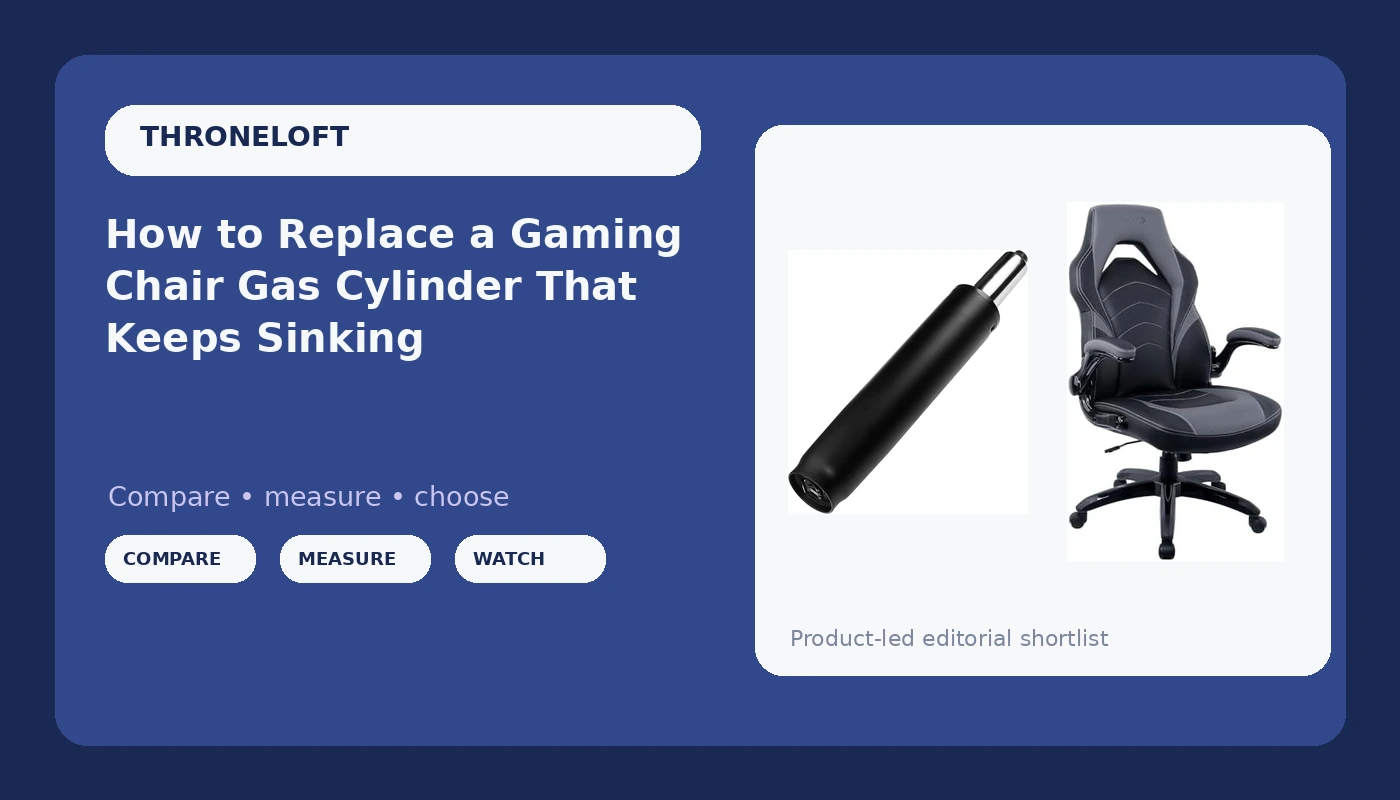
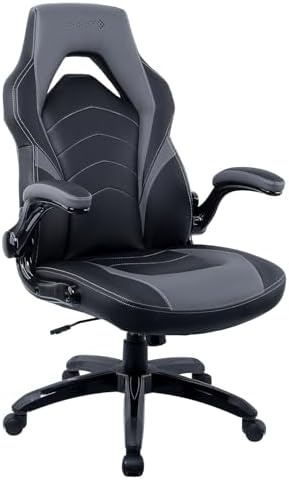
The chair: STAPLES Emerge Vortex Gaming Chair, Adjustable Height, Swivel Black
 Visit on Amazon →
This is a black swivel chair with an adjustable height range, which means it rides on a gas lift cylinder. That is the same architecture as almost every office chair and gaming chair on the market, and it is the reason a cylinder swap is even possible on it. Adjustable height is a feature until the day it becomes a sinking problem, and then it becomes a repair.
The reason I point at a chair in this format is the parts underneath it. It is a standard swivel task chair shape, not a bucket-seat racing shell, so what holds it up is standard hardware: a five-star base, a gas lift, a mechanism, a seat plate. Standard parts are repairable parts. If you are buying a chair with the intention of keeping it for years, that matters more than the color of the stitching.
Caveats worth knowing: Confirm the seat plate is bolted and not riveted before you plan a repair on any chair. Check current Amazon price and compare it against what you would spend on a chair you cannot fix.
The part: 5" Chair Hydraulic Cylinder Replacement for Office Chair Gas Lift Cylinder
 Visit on Amazon →
This is the replacement part itself: a 5 inch class gas lift cylinder for an office chair. It is the pressurized tube that sits between the base and the mechanism, and it is the part doing the sinking. Check current Amazon price before you assume the repair is not worth the effort.
Flaws but not dealbreakers: A cylinder is only as good as its fit. Before ordering, measure your old cylinder's length class and taper diameter. If your chair uses a different height class, or a threaded mount instead of a taper fit, this one will not drop in and you will be sending it back. Measure first, order second.
Anyone with a sinking chair, a bolted seat plate, and a base hub that is not cracked is a candidate for this fix. If the hub is split, put the money toward a new base instead.
The actual replacement workflow
Step one: Confirm the diagnosis. Sit in the chair and set the height. If it holds at first and then sinks slowly under your weight, the gas charge is gone. If it drops instantly the moment you touch the lever, the actuator may be the problem instead, and that is a different repair. If it wobbles side to side at the top of the cylinder, the taper has worn and the cylinder needs replacing regardless. Rule out the base and the casters by checking whether the movement is at the center hub or out in the legs.
Step two: Measure the old cylinder. Flip the chair. Measure the full length of the cylinder from the bottom of the taper to the top of the tube, then measure the taper diameter at the bottom. Write both numbers down and match them to the part you order. This is the step people skip, and it is the step that causes returns.
Step three: Strip the chair. Remove the seat from the mechanism. Usually four bolts on the underside, sometimes with a plastic shroud you have to pop off first. Set the bolts in a cup so they do not vanish into the carpet. Take the seat off and set it aside.
Step four: Free the base from the cylinder. With the mechanism and seat removed, you have a five-star base with the cylinder sticking up out of the center hub. The cylinder is pressed into a taper, and years of sitting have made that fit tight. Two methods work. Method one: stand the base on the floor, straddle it, grip the cylinder near the base with a pipe wrench or strap wrench and twist. Method two: with the base braced upside down, tap the bottom of the cylinder with a rubber mallet, or with a hammer on a block of wood.
Never strike the cylinder body directly with a metal hammer, and never apply heat. There is pressurized gas inside.
If it will not budge, soak the joint with penetrating oil and come back in an hour. Do not improvise with a torch, and do not drill anything.
Step five: Separate the cylinder from the mechanism. The top of the cylinder is pressed into the mechanism's tube. Clamp the cylinder in a vise with the mechanism up, then twist and pull the mechanism off. If the fit is stubborn, a strap wrench around the mechanism plus steady force beats brute force every time. Take your time here. You are trying not to deform the tube.
Step six: Inspect before you install. Look at the base hub for cracks. Look at the mechanism tube for deformation. Look at the seat plate bolts for stripped threads. If any of those are bad, stop and order the part you actually need, because a new cylinder will not fix a cracked hub or a bent mechanism.
Step seven: Install the new cylinder. Drop the cylinder into the base hub, taper first, and press down firmly. The taper does the locating, so it should seat without tools. Then press the mechanism onto the top of the cylinder. A few taps on a block of wood laid across the mechanism will seat it. Do not hammer the cylinder itself, and do not hammer the height lever.
Step eight: Reassemble and test. Bolt the seat back to the mechanism, tightening in a cross pattern so the plate does not cock, then set the chair upright. Test the height lock at the lowest and highest positions. Test the swivel. Sit down and lean back to check the tilt. Then sit for an hour and confirm the height holds. If it still sinks, the mechanism or the taper is the problem, not the new part.
Safety notes: wear eye protection when you are swinging a mallet under a chair, and keep your fingers clear of the taper joint when it breaks loose. Gas cylinders stay under pressure even after they fail, so do not cut them, drill them, or heat them.
One more thing: check your chair's warranty before you start. Some chairs cover the gas lift for years, and taking a wrench to the base can void that coverage. If the chair is new and the cylinder is failing, the warranty is the cheaper repair.
The competition and why it lost
The main alternative to a cylinder replacement is a new chair, and sometimes that is the correct call. If the frame is bent, the mechanism is cracked, the base hub is split, or the seat plate is riveted so you cannot get the chair apart, buy the chair. Repair only makes sense on a chair that was built to come apart.
The second alternative is a complete base-and-cylinder assembly, sold as one unit. That costs more than the cylinder alone, and it makes sense when your base is also cracked or the casters are shot. If your base is fine, you are paying for parts you already own.
The third option is a chair with no gas lift at all, a fixed-height task chair or a stool. No cylinder means no sinking, but it also means no height adjustment, and height adjustment is not a luxury. It is how you get your knees to a right angle and your feet flat on the floor. I would rather replace a cylinder every few years than sit at the wrong height every single day.
What did not make the list: bucket-seat racing chairs as a category, because the shape fights your posture no matter how good the cylinder underneath it is. If you are replacing a chair anyway, buy the shape that supports you and skip the car seat.
What this all costs
The math on this repair is not close.
- The replacement cylinder: Check current Amazon price.
- A new chair: many times the part, for a chair you already own in working condition.
- A shop or a handyman: labor that usually exceeds the price of the part.
If the cylinder costs a small fraction of what the chair cost, the repair wins. If the chair was cheap and the base is also cracked, the new chair wins. That is the whole decision, and it takes five minutes with a tape measure and a wrench.
What I tell my players is the same thing I tell everyone who asks me about their setup: the chair is the tool you spend the most hours in, and it is the one piece of gear nobody thinks to maintain. Fix the part that fails. Do not throw away a good chair because of a bad cylinder.